Introduction: Creativity Is No Longer Just a Hobby
What if the thing you love doing in your free time could become the career you build your future around?
In 2026, creativity is becoming more valuable than ever. Brands need attention-grabbing visuals, creators need unique identities, businesses need social media content, and digital platforms constantly demand fresh visual experiences. This is where graphic designing comes into the picture.
For Gen-Z, graphic designing is not simply about creating attractive posters or choosing beautiful colors. It is about turning ideas into visual experiences that people can understand, remember, and connect with.
Whether you are a student exploring career options, a beginner who loves creativity, or someone already experimenting with Photoshop, Illustrator, Canva, or AI tools, the creative industry offers exciting possibilities.
The best part? You don’t need to fit into a traditional career path.
You can work with brands, become a freelancer, join a creative agency, build your own design studio, or create a personal brand around your skills.
What Is Graphic Designing?
Graphic designing is the process of communicating ideas through visual elements such as typography, images, colors, illustrations, layouts, icons, and digital graphics.
A designer combines creativity with communication to create visuals that have a purpose.
Think about the last Instagram post, YouTube thumbnail, product advertisement, website banner, or brand logo that caught your attention.
Someone designed that visual.
Behind every successful design is a combination of:
- Creativity
- Visual communication
- Typography
- Color theory
- Composition
- Branding
- Technology
- Understanding of the target audience
Modern graphic designing has expanded far beyond traditional print media. Today, designers create everything from social media posts and websites to motion graphics, advertisements, app interfaces, packaging, and digital campaigns.
Why Graphic Designing Is Important in 2026
We live in a visual-first digital world.
People scroll through hundreds of posts every day. Brands have only a few seconds to capture attention. A strong visual can stop someone from scrolling, communicate an idea quickly, and create an emotional connection.
This makes graphic designing an important part of marketing, branding, entertainment, education, e-commerce, and content creation.
In 2026, businesses are also producing content across multiple platforms. One campaign may require Instagram posts, reels, YouTube thumbnails, website banners, advertisements, presentations, and promotional graphics.
That creates a growing need for designers who understand not only aesthetics but also digital communication.
Why businesses need designers
- To create memorable brand identities
- To communicate products and services visually
- To build professional social media profiles
- To create advertisements and marketing campaigns
- To improve customer engagement
- To make websites and digital platforms visually appealing
- To stand out in competitive markets
In simple words, good design can help a brand say more without using more words.
Graphic Designing Meets AI in 2026
One of the biggest changes in graphic designing is the growing influence of artificial intelligence.
AI tools can help designers generate ideas, create variations, remove backgrounds, experiment with styles, organize workflows, and speed up repetitive tasks.
But there is an important distinction:
AI can generate visuals. Designers create meaning.

A professional designer still needs to understand the brand, audience, message, composition, visual hierarchy, and emotional impact of a design.
Instead of seeing AI as the enemy, Gen-Z designers can treat it as a creative assistant.
AI can help designers with:
- Idea generation
- Creative brainstorming
- Image creation
- Background removal
- Design variations
- Content resizing
- Repetitive production tasks
- Concept visualization
- Faster experimentation
The designers who learn how to combine human creativity with modern technology can create more efficiently while keeping their own creative thinking at the center.
Essential Skills Every Graphic Designer Should Develop
Learning software is important, but becoming a successful designer requires more than knowing where the buttons are.
Your real advantage comes from developing creative and strategic thinking.
1. Visual Communication
A design should communicate something clearly.
Ask yourself:
What should the viewer understand within the first few seconds?
If the answer is unclear, the design probably needs improvement.
2. Typography
Fonts influence personality and readability. A luxury brand, gaming company, children’s product, and financial institution may require completely different typography choices.
Understanding font pairing, spacing, hierarchy, and readability can significantly improve your work.
3. Color Theory
Colors can influence mood, attention, and brand perception.
Learning color relationships, contrast, saturation, and visual balance gives you greater control over your designs.
4. Layout and Composition
A professional design needs structure.
Elements should guide the viewer’s eyes naturally instead of competing for attention.
5. Branding
Modern graphic designing is closely connected with branding.
A designer should understand how logos, colors, typography, imagery, and visual styles work together to create a consistent identity.
6. Creative Problem-Solving
Clients rarely say, “Please solve this visual communication problem.”
Instead, they may say:
“Make it look more professional.”
Your job is to understand what they actually need and turn that requirement into a visual solution.
Career Opportunities in Graphic Designing
One of the most exciting things about graphic designing is the number of career paths available.
You don’t have to choose just one direction forever.
You can explore different areas and discover what matches your interests.
Popular career paths include:
- Graphic Designer
- Brand Identity Designer
- Social Media Designer
- UI/Visual Designer
- Advertising Designer
- Packaging Designer
- Motion Graphics Designer
- Creative Director
- Freelance Designer
- Content Designer
- Thumbnail Designer
- Illustration Artist
You can also combine design with other skills such as digital marketing, video editing, content creation, or web development.
This combination can make your creative profile more versatile.
Freelancing: Build Your Own Creative Career
Gen-Z is increasingly interested in flexible and independent career options, and graphic designing fits naturally into the freelance ecosystem.
As a freelancer, you can work with startups, creators, local businesses, agencies, e-commerce brands, and international clients.
However, freelancing is not simply about creating beautiful designs.
You also need to learn:
- Client communication
- Project management
- Pricing
- Time management
- Portfolio building
- Negotiation
- Meeting deadlines
- Understanding client requirements

Your portfolio becomes your visual resume.
Instead of telling people that you are creative, show them what you can create.
How to Start Your Graphic Designing Journey
You don’t need to master everything on day one.
Start small, practice consistently, and gradually increase the difficulty of your projects.
A simple learning roadmap
Step 1: Learn the fundamentals
Start with typography, color theory, composition, spacing, hierarchy, and branding basics.
Step 2: Learn design software
Explore tools such as Adobe Photoshop, Adobe Illustrator, Figma, Canva, or other suitable creative platforms.
Step 3: Recreate designs for practice
Choose advertisements, posters, social media graphics, or branding projects and recreate them as learning exercises.
Step 4: Create original projects
Move beyond tutorials and develop your own concepts.
Step 5: Build a portfolio
Show your strongest projects instead of uploading everything you have ever created.
Step 6: Get feedback
Share your work with other designers, mentors, teachers, or creative communities.
Step 7: Start working on real projects
Try internships, freelance projects, collaborations, or projects for small businesses.
Consistency matters more than trying to become perfect overnight.
What Makes a Designer Stand Out in 2026?
The design industry is competitive, so simply knowing software may not be enough.
Your ability to think differently can become your biggest advantage.
A standout designer understands:
- The audience
- The brand
- The message
- Current visual trends
- Digital platforms
- User behavior
- Storytelling
- AI-assisted workflows
Most importantly, they develop a recognizable creative perspective.
Trends change quickly.
Your ability to learn should not.
Common Mistakes Beginners Should Avoid
Starting a creative career can be exciting, but beginners often make similar mistakes.
Avoid these common problems:
- Copying other designers without understanding the principles
- Using too many fonts
- Adding unnecessary effects
- Ignoring spacing and alignment
- Following every trend blindly
- Focusing only on software skills
- Building a portfolio filled with unrelated work
- Refusing to accept constructive feedback
- Expecting instant success
Remember: becoming good at graphic designing is a process.
Your first design may not look professional.
That’s completely okay.
Every designer starts somewhere.
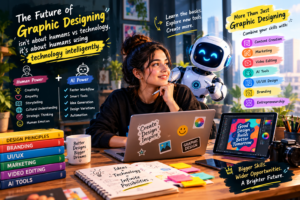
The Future of Graphic Designing Belongs to Creative Thinkers
The future of graphic designing isn’t about humans versus technology.
It is about humans using technology intelligently.
AI may make certain tasks faster, but creativity, empathy, storytelling, cultural understanding, strategic thinking, and human emotion remain powerful parts of visual communication.
For Gen-Z, this creates an interesting opportunity.
You can learn traditional design principles while experimenting with new technologies. You can combine graphic designing with content creation, marketing, video, AI, UI, branding, and entrepreneurship.
The possibilities are wider than ever.
Conclusion: Your Creativity Can Become Your Career
Graphic designing in 2026 is more than a creative skill—it can be a pathway to building a career around your imagination.
You don’t need to have everything figured out today.
Start with curiosity.
Learn the fundamentals. Experiment with tools. Create projects. Build your portfolio. Take feedback. Keep improving.
Most importantly, don’t wait for someone to give you permission to be creative.
Your ideas have value.
Your creativity can become a skill.
And with the right learning, practice, technology, and mindset, that skill can become a career that you are genuinely proud of.
The future isn’t asking you to simply follow a career path.
It is giving you the opportunity to design your own.