In today’s digital world, businesses are no longer dependent only on traditional advertising. People search for information, compare products, read reviews, watch videos, and explore brands before making a decision.
This is why understanding what is content marketing has become important for businesses, students, creators, and aspiring digital marketers.
Content marketing focuses on creating and sharing useful, relevant, and valuable content to attract an audience, build trust, and encourage meaningful action.
But what is content marketing really about? It is much more than writing blogs or posting on social media. It is a strategic approach that connects valuable content with audience needs and business goals.
What Is Content Marketing?
So, what is content marketing in simple words?
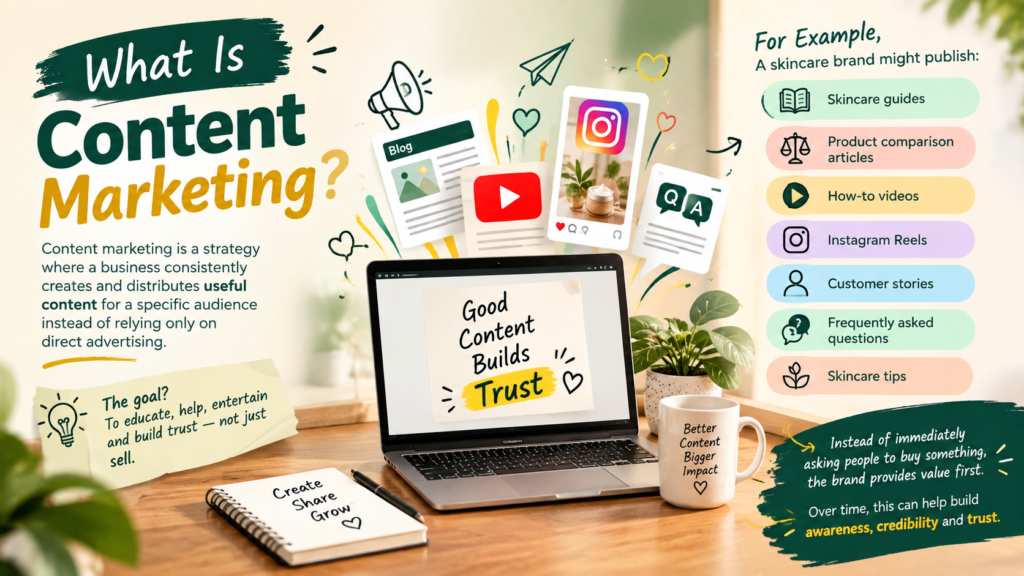
Content marketing is a strategy in which a business creates and distributes useful content for a specific audience instead of relying only on direct advertising.
The content can educate, entertain, answer questions, solve problems, or help people make better decisions.
For example, a skincare brand could publish:
- Skincare guides
- Product comparison articles
- How-to videos
- Instagram Reels
- Customer stories
- Skincare tips
- Frequently asked questions
Instead of immediately asking people to buy something, the brand provides value first. This approach can gradually build awareness, credibility, and trust.
Why Is Content Marketing Important?
Understanding what is content marketing also means understanding why businesses use it.
People rarely become customers the first time they discover a brand. They may need several interactions before they feel confident enough to make a purchase.
Useful content can keep a business connected with potential customers throughout this journey.
1. Builds Brand Awareness
One important part of what is content marketing is using valuable content to introduce your brand to new audiences.
A useful blog, video, infographic, or social media post can reach people who are searching for information related to your products or services.
2. Builds Trust and Credibility
When a business consistently shares helpful information, it can demonstrate knowledge and expertise.
For example, a digital marketing company that regularly publishes SEO guides can become a useful resource for people interested in digital marketing.
3. Supports SEO
Content and SEO work closely together.
Businesses can create content around relevant search queries and topics their audiences are interested in. With proper optimization, useful content can attract organic traffic from search engines.
This is one reason what is content marketing is an important topic for anyone learning digital marketing.
4. Helps Customers Make Decisions
Another answer to what is content marketing can be found in its role during the buying journey.
Good content can answer questions customers have before purchasing.
It can explain:
- How a product works
- Which solution may be suitable
- What benefits a service provides
- How products compare
- How to solve a specific problem
How Does Content Marketing Work?
Now that you understand what is content marketing, let’s look at how the process works.
A successful strategy generally follows several important steps.
Step 1: Understand Your Audience
First, identify the people you want to reach.
Consider:
- Their interests
- Problems
- Questions
- Goals
- Buying behavior
- Preferred content formats
When you understand your audience, you can create content that is more relevant and useful.
Step 2: Set Clear Goals
Every piece of content should have a purpose.
Your goals could include:
- Increasing brand awareness
- Generating website traffic
- Getting leads
- Building authority
- Increasing engagement
- Supporting sales
- Improving customer retention
Knowing what is content marketing is not enough. You also need to understand how content supports your specific business objective.
Step 3: Choose Relevant Topics
Research topics your audience actually wants to learn about.
You can discover ideas through:
- Keyword research
- Customer questions
- Competitor research
- Social media discussions
- Industry trends
- Online communities
Choosing relevant topics makes your content more likely to attract the right audience.
Step 4: Create Valuable Content
Create content that provides a clear benefit to the reader or viewer.
Before publishing, ask yourself:
“Does this content answer a real question or solve a genuine problem?”
If the answer is yes, your content has a stronger chance of being useful.
Step 5: Distribute the Content
Creating content is only half the process.
You also need to distribute and promote it through suitable channels, such as:
- Search engines
- Social media
- Email newsletters
- YouTube
- Online communities
- Business websites
Step 6: Measure and Improve
Finally, analyze your results.
Track metrics such as:
- Website traffic
- Engagement
- Clicks
- Time spent on pages
- Leads
- Conversions
- Social shares
Use these insights to improve your future content strategy.
Types of Content Marketing
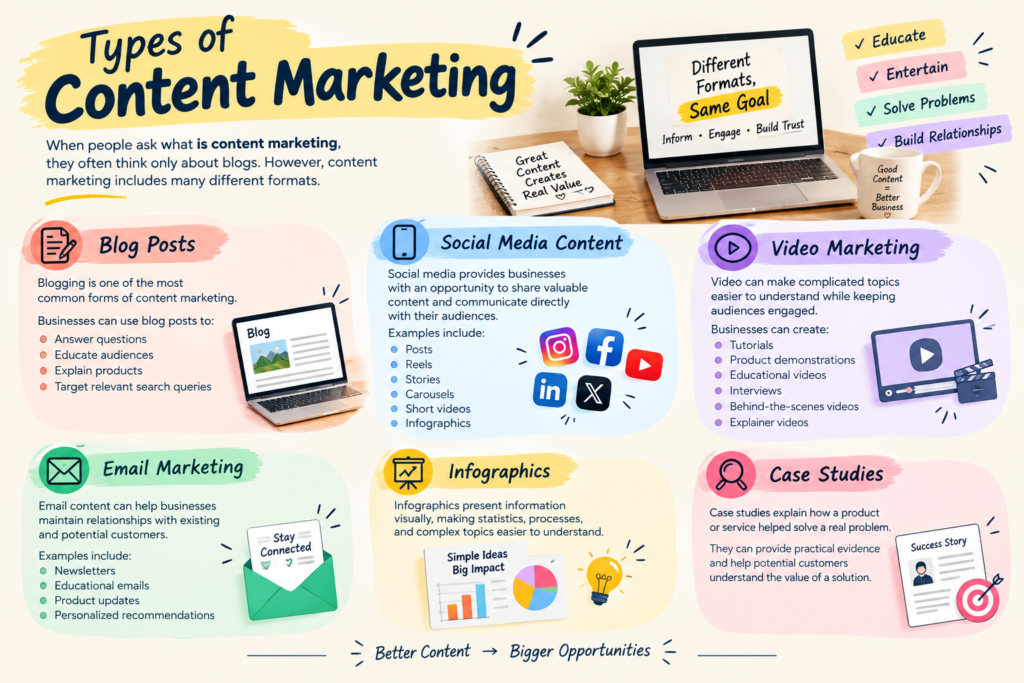
When people ask what is content marketing, they often think only about blogs. However, content marketing includes many different formats.
Blog Posts
Blogging is one of the most common forms of content marketing.
Businesses can use blog posts to answer questions, educate audiences, explain products, and target relevant search queries.
Social Media Content
Social media provides businesses with an opportunity to share valuable content and communicate directly with their audiences.
Examples include:
- Posts
- Reels
- Stories
- Carousels
- Short videos
- Infographics
Video Marketing
Video can make complicated topics easier to understand while keeping audiences engaged.
Businesses can create:
- Tutorials
- Product demonstrations
- Educational videos
- Interviews
- Behind-the-scenes videos
- Explainer videos
Email Marketing
Email content can help businesses maintain relationships with existing and potential customers.
Examples include newsletters, educational emails, product updates, and personalized recommendations.
Infographics
Infographics present information visually, making statistics, processes, and complex topics easier to understand.
Case Studies
Case studies explain how a product or service helped solve a real problem.
They can provide practical evidence and help potential customers understand the value of a solution.
Content Marketing vs Traditional Advertising
Another useful part of understanding what is content marketing is knowing how it differs from traditional advertising.
Traditional advertising generally focuses on directly promoting a product, service, or offer.
Content marketing takes a more value-driven approach.
| Content Marketing | Traditional Advertising |
|---|---|
| Focuses on providing value | Focuses mainly on promotion |
| Builds relationships over time | Often focuses on immediate attention |
| Educates or entertains audiences | Communicates an offer |
| Can generate long-term organic traffic | Usually requires ongoing ad spending |
| Uses blogs, videos, guides, and social content | Uses commercials, banners, and advertisements |
Both approaches can be useful. The right choice depends on your audience, goals, budget, and overall marketing strategy.
Benefits of Content Marketing
Learning what is content marketing becomes more useful when you understand the benefits it can provide to a business.
Long-Term Traffic
High-quality content can continue attracting visitors after publication, particularly when it performs well in search results.
Better Audience Engagement
Useful and interesting content gives people a reason to interact with your brand.
Stronger Brand Authority
Consistently sharing valuable information can help position a business as a trusted resource in its industry.
More Qualified Leads
Helpful content can attract people who are already interested in a particular problem, topic, product, or service.
Supports Other Marketing Channels
One piece of content can often be repurposed into multiple formats.
For example, a single blog post can become:
- Social media posts
- Short videos
- An email newsletter
- An infographic
- A carousel
- A video script
This makes content more efficient and versatile.
Common Content Marketing Mistakes
Knowing what is content marketing is only the beginning. You also need to understand the mistakes that can make a strategy unsuccessful.
Avoid:
- Creating content without understanding your audience
- Publishing without a clear objective
- Focusing only on selling
- Copying competitors
- Ignoring SEO
- Publishing low-quality content
- Using irrelevant keywords
- Not promoting published content
- Ignoring analytics
- Expecting immediate results
Content marketing usually requires consistency, testing, and continuous improvement.
How to Create a Simple Content Marketing Strategy
If you are a beginner, you do not need a complicated strategy.
Start with these steps:
1. Define your audience
Understand who you want to reach and what they need.
2. Choose your main goal
Decide whether you want traffic, awareness, leads, engagement, or sales.
3. Select content formats
Choose formats that match your audience and available resources.
4. Create a content calendar
Plan topics and publishing dates in advance.
5. Optimize your content
Use relevant keywords, clear headings, engaging titles, and useful information.
6. Promote your content
Share it through relevant social platforms, email, communities, and other channels.
7. Track performance
Review your results and improve your strategy based on data.
Is Content Marketing Useful for Small Businesses?
Absolutely.
Small businesses may not have the advertising budgets of large companies, but they can compete by creating useful and highly relevant content for a specific audience.
For example, a local fitness business could publish:
- Beginner workout guides
- Healthy lifestyle tips
- Exercise tutorials
- Customer success stories
- Frequently asked questions
This content can attract people who are already interested in the business’s products or services.
Understanding what is content marketing can therefore help small businesses use their existing knowledge and expertise to build an online presence.
What Skills Do You Need for Content Marketing?
If you want to build a career in this field, learning what is content marketing is a good starting point.
You can gradually develop skills such as:
- Content writing
- Keyword research
- SEO
- Social media marketing
- Copywriting
- Audience research
- Content planning
- Basic graphic design
- Video content creation
- Analytics
- Content strategy
You do not need to master everything immediately. Start with the fundamentals and develop your skills through practical projects.
How to Measure Content Marketing Success
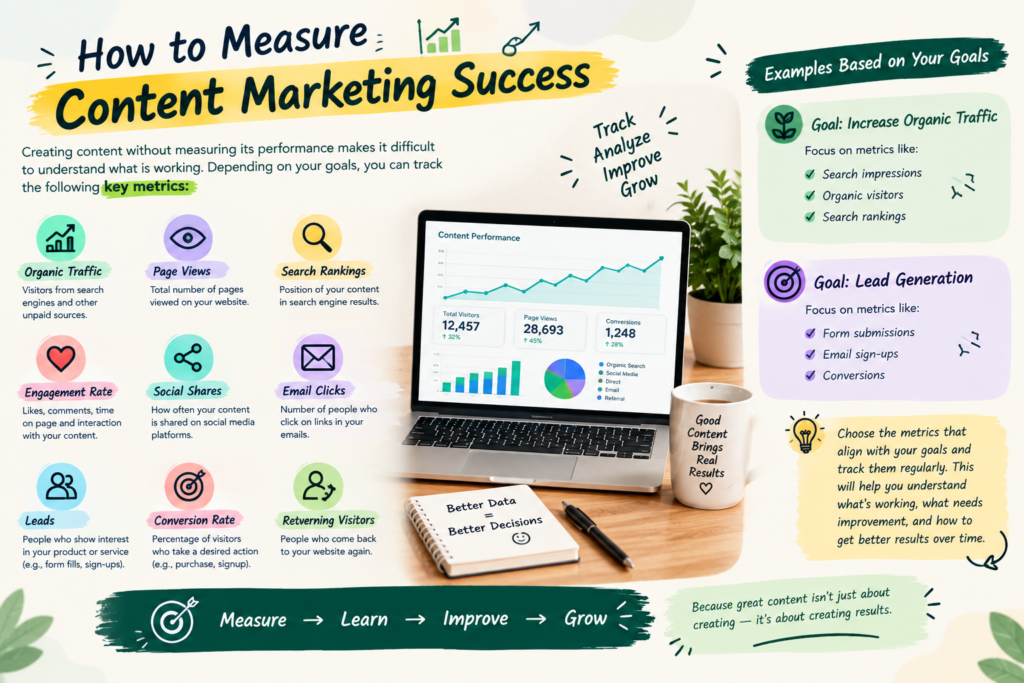
Creating content without measuring its performance makes it difficult to understand what is working.
Depending on your goals, you can track:
- Organic traffic
- Page views
- Search rankings
- Engagement rate
- Social shares
- Email clicks
- Leads
- Conversion rate
- Returning visitors
For example, if your goal is increasing organic traffic, search impressions and organic visitors may be important metrics.
If your goal is lead generation, form submissions and conversions may matter more.
Final Thoughts
Understanding what is content marketing is essential for anyone who wants to build a strong digital presence.
Content marketing is not about creating as much content as possible. It is about creating the right content for the right audience at the right time.
Whether you are a business owner, student, freelancer, creator, or aspiring digital marketer, learning how to research, create, distribute, and measure valuable content can become an important professional skill.
The key is to focus on usefulness, consistency, relevance, and genuine audience needs rather than simply chasing views or clicks.
Where Can We Learn Content Marketing?
If you want to learn content marketing in a structured and practical way, you can explore content marketing learning opportunities at DizitalMantras Institute.
DizitalMantras can help learners understand important digital marketing concepts and develop practical skills related to content creation, SEO, social media, and online marketing.
For beginners who want to understand what is content marketing and learn how it can be applied to real digital marketing activities, exploring learning opportunities at DizitalMantras Institute can be a useful step toward building practical knowledge and confidence.